

Best Archery Gear for Beginners: A Complete Starter Guide
Table of Contents
- Best Archery Gear for Beginners: What You Actually Need
- Choosing Your First Bow: Recurve vs. Compound
- Understanding Draw Weight and Draw Length
- How to Choose Arrows for a Bow
- Essential Accessories and Safety Gear
- Complete Beginner Setup: What to Buy First and What to Skip
- Frequently Asked Questions
Last Updated: October 5, 2026
Best Archery Gear for Beginners: What You Actually Need
Starting archery doesn't require dropping hundreds on equipment you won't use. At Kansas Archery Center LLC, we help archers of all levels find the right gear without overspending or buying the wrong setup. The key is understanding what matters at the start and what can wait until you've committed to the sport.
Most beginners make one critical mistake: they buy based on what looks cool rather than what fits their body and skill level. A bow that's too heavy, arrows with the wrong spine, or accessories designed for competitive shooters will frustrate you and slow your progress. The good news is that solid beginner gear exists at reasonable prices, and you don't need to choose between quality and affordability.
This guide covers the essential archery gear for beginners, from selecting the right bow type to understanding draw weight and arrow matching. We'll break down what to buy first, what to skip, and how to build a complete starter setup that actually works.
Choosing Your First Bow: Recurve vs. Compound
Your bow choice shapes everything else. The two main options are recurve and compound bows, and each serves different purposes and skill levels.
Recurve bows have a simpler design: one string, curved limbs, and no mechanical parts. They're lighter, quieter, and easier to maintain. They also require more upper body strength and technique because you're holding the full draw weight at full draw. Recurve bows teach proper form faster because there's no let-off to mask mistakes. They're also cheaper to start with.
Compound bows use a system of pulleys and cams to reduce the force you hold at full draw. Most compounds offer 65-80% let-off, meaning if the bow is set to 60 pounds, you only hold about 12-18 pounds at full draw. This makes them forgiving for beginners with less upper body strength. They're more complex, require tuning, and cost more upfront. But they're more forgiving on form mistakes and more stable for accuracy.
For most beginners, compound bows are the better choice. The reduced hold weight means you can focus on aiming and consistency rather than fighting the draw. If you're younger, smaller, or less experienced, a compound bow removes a significant barrier to learning proper technique.
Best Beginner Recurve Bow
If you choose recurve, you're looking at simpler equipment but higher physical demands.
Best Beginner Compound Bow
The Mission Stryde 28 and Mission Stryde 30.5 are purpose-built entry-level compound bows. Both feature the Mission Solocam, a smooth single-cam system that works across many draw lengths without needing custom tuning. The Stryde 28 is compact at 28 inches axle-to-axle, making it easier to handle in tight spaces. The Stryde 30.5 is slightly longer and more forgiving on form inconsistencies.

Both models come with Lite limbs that range from 30-50 pounds or Standard limbs from 50-70 pounds. Start with the Lite limbs unless you have prior archery experience. At $599.99 for the Stryde 28 and $649.99 for the Stryde 30.5, these bows deliver professional-grade features without the premium price tag. The 3D Damping technology reduces noise and vibration, which matters when you're learning consistency.
The key advantage: both handle draw lengths from 21-30 inches, so they fit many body types.
Understanding Draw Weight and Draw Length
Draw weight and draw length are the two measurements that determine whether a bow fits you properly. Get these wrong, and you'll struggle with accuracy and form.
Beginner Bow Draw Weight Explained
Draw weight is how many pounds of force you need to pull the bowstring to full draw. A 40-pound bow requires 40 pounds of pulling force. A 50-pound bow requires 50 pounds.
Most beginners choose too heavy a draw weight. The logic seems sound: heavier bows shoot faster and hit harder. But if you can't control the draw, you'll develop poor form habits that stick with you. Fatigue also ruins accuracy. After 20 shots with a bow that's too heavy, your muscles tire and your shots scatter.
For beginners, 30-40 pounds is the right starting range. If you're under 150 pounds or have limited upper body strength, start at 30 pounds. If you're taller or stronger, 35-40 pounds works. You can always increase draw weight later by swapping limbs on a takedown bow or upgrading to a heavier compound.
Draw length is how far you pull the bowstring. It's measured in inches from the nocking point to the back of the bow grip. A typical adult has a draw length between 26 and 30 inches. To find yours, measure your arm span and divide by 2.5.
Both the Mission Stryde models accommodate draw lengths from 21-30 inches, so they fit most adults without modification. This is a major advantage for beginners because it means one bow works for different body types.

How to Choose Arrows for a Bow
Arrows matter more than beginners think. Using the wrong arrow can damage your bow, ruin accuracy, or even break the arrow mid-flight.
The critical measurement is arrow spine, which refers to how much the arrow bends under load. Spine is rated by a number: 200, 250, 300, 350, 400, 500, or 600. Higher numbers mean stiffer arrows. A lighter bow needs a more flexible arrow (higher number).
For a 30-40 pound beginner compound bow, you'll typically need arrows in the 400-500 spine range. The exact spine depends on your draw length and arrow weight. When you buy arrows, you should know your bow weight and draw length to select the right spine.
Bear 28" Safety Glass Arrows at $3.99 per arrow are ideal for youth archers or those just testing the sport. These fiberglass arrows are durable, won't splinter, and come pre-fletched and nocked. They're not the fastest or most accurate arrows, but they're safe and affordable for learning basics.

For more serious practice, the 5mm Axis Fletched Arrows at $119.99 for a 6-pack offer superior accuracy and flight. These micro-diameter carbon arrows penetrate better and fly straighter in crosswinds. They're matched for weight and spine, so they work together as a set. The factory helical fletching improves stability.
Bear 28" Safety Glass Arrows →
The HLR Sport Fletched Arrows at $114.99 for a 6-pack split the difference. They're engineered for speed and long-range accuracy with a high-modulus carbon structure. The 50-grain insert system lets you adjust weight to your preference. These work well for hunters preparing for the season.
One critical rule: arrow spine weight must match or be higher than your bow weight. Mismatched arrows damage equipment and ruin accuracy. When you order, ensure you select the right spine for your bow weight and draw length.
Essential Accessories and Safety Gear
Beyond the bow and arrows, you need protective gear and aiming aids. These aren't optional if you want to shoot safely and consistently.
An arm guard protects your inner arm from the bowstring snap when you release. A finger tab protects your fingers from the string and helps you release smoothly. A release aid (for compound bows) gives you a consistent, clean release. These three items matter far more than most beginners realize.
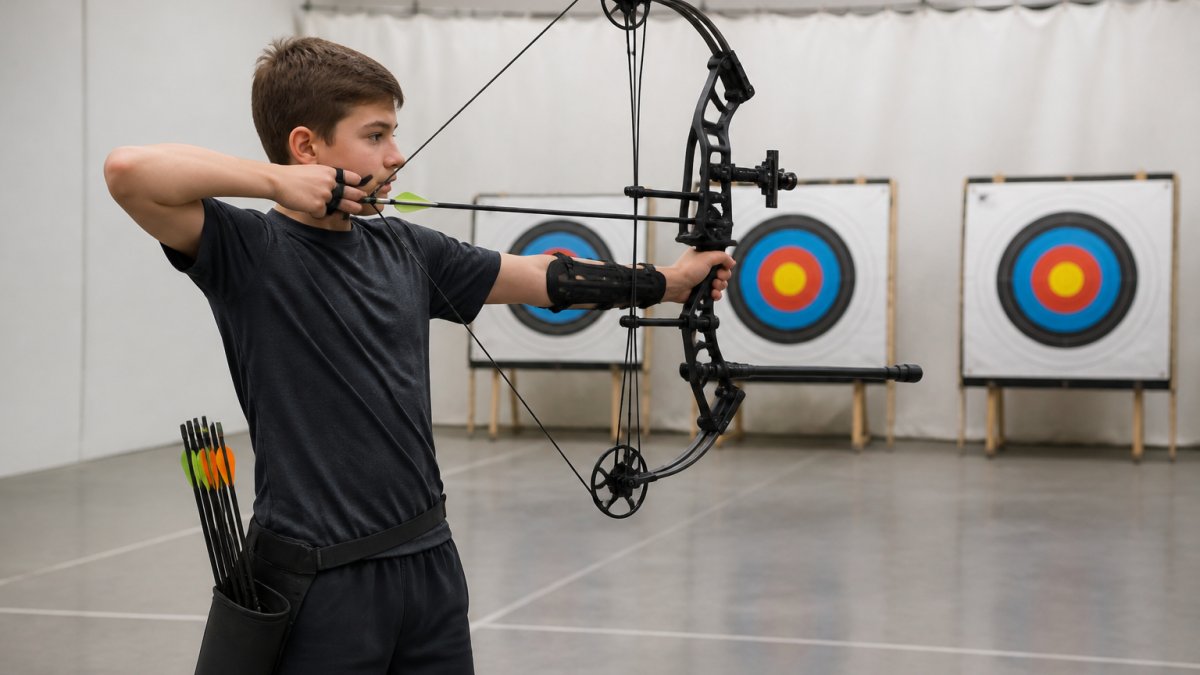
A bow sight helps you aim consistently. Entry-level sights are simple: a single pin or three-pin setup that you align with your target. A fiber-optic sight is easier to see in low light. A five-pin sight gives you options for different distances. Don't overthink this at the start. A basic three-pin sight works fine for beginners.
An arrow rest holds your arrow on the bow before you shoot. Compound bows usually come with a rest.
A quiver holds your arrows. The Easton DLX Field Quiver at $124.99 is designed for target archers. It's compact, holds plenty of arrows, and includes pockets for accessories. The fleece-lined interior keeps arrows quiet and organized.
For practice, you'll also need a target. The McKenzie Predator 24" at $219.99 is rated for speeds up to 450 FPS and handles both broadheads and field points. The removable core means you can replace the worn center without buying a new target. It's a solid investment for serious practice.
Finally, grab an Avalon Classic Archery Gauge at $12.99. This tool checks nock height, brace height, and tiller. It seems minor, but proper setup prevents accuracy problems before they start.
| Accessory | Purpose | Beginner Priority | Estimated Cost |
|---|---|---|---|
| Arm Guard | Protects inner arm | Essential | $10-20 |
| Finger Tab | Protects fingers, improves release | Essential | $10-25 |
| Bow Sight | Helps with aiming | Essential | $30-80 |
| Arrow Rest | Holds arrow on bow | Essential | $20-50 |
| Release Aid | Smooth, consistent release | High | $25-60 |
| Quiver | Carries arrows | High | $40-125 |
| Target | Practice surface | High | $100-250 |
| Archery Gauge | Setup and tuning | Medium | $10-15 |
Complete Beginner Setup: What to Buy First and What to Skip
Here's a realistic breakdown of what a beginner setup costs and where to focus your budget.
Start with these (non-negotiable):
- Compound bow (Mission Stryde 28 or 30.5): $599.99-$649.99
- Arrows (5mm Axis or HLR Sport, 6-pack): $114.99-$119.99
- Arm guard: $10-20
- Finger tab: $10-25
- Bow sight (basic three-pin): $30-60
- Arrow rest: $20-50
- Quiver: $40-125
- Target: $100-250
Total for a solid beginner setup: roughly $1,000-$1,400
This gets you everything needed to practice safely and learn proper form. You're not overspending on premium gear you won't use, but you're not cutting corners on safety or accuracy.
What to skip initially:
- Release aids (finger release works fine for beginners)
- Multiple sights or sight pins beyond three
- Expensive broadheads (use field points for practice)
- Stabilizers or dampening systems (nice to have, not essential)
- Rangefinders or advanced aiming tools
- Custom bowstrings (stock strings work fine)
As you progress and shoot more, you'll identify what actually matters for your style. Maybe you want a release aid for consistency. Maybe you add a second bow for different purposes. These decisions come later, after you understand what you actually need.
Many beginners also assume they need to buy everything at once. You don't. Start with a bow, arrows, basic protective gear, and a sight. Practice for a few months. Then add a target, quiver, and gauge as your commitment deepens.
Starting archery is accessible and affordable when you focus on the fundamentals. The best archery gear for beginners balances quality, fit, and value. A Mission Stryde compound bow with matched arrows, protective gear, and a basic sight gives you everything needed to learn proper form and build consistency. At Kansas Archery Center LLC, we stock authorized gear from trusted brands and our own custom bowstrings, backed by fast shipping and expert support. Whether you're preparing for hunting season or exploring archery as a hobby, we help you find equipment that fits your needs and budget. Subscribe and become a member to earn points every time you shop.
Frequently Asked Questions
What is the best archery gear for beginners to start with?
Begin with a quality starter bow (recurve or compound depending on your preference), properly matched arrows with the correct spine, a finger tab or release aid, an arm guard, and a target. The Mission Stryde compound bows offer beginner-friendly draw weights starting at 30 lbs with adjustable settings, while entry-level recurve bows provide simplicity and lower cost. Budget $600-$800 for a complete beginner setup including bow, arrows, and essential safety gear.
How do I choose arrows for a bow?
Arrow selection depends on your bow's draw weight, draw length, and intended use. Match the arrow spine (stiffness) to your bow's poundage; arrows too light or heavy will fly poorly and can be unsafe. For beginners, fiberglass arrows like Bear Safety Glass Arrows ($3.99) are durable and forgiving, while carbon options like HLR Sport Fletched Arrows ($114.99) offer better accuracy. Always verify that arrow spine weight matches or exceeds your bow's draw weight.
Should a beginner choose a recurve bow or compound bow?
Compound bows like the Mission Stryde ($599.99-$649.99) offer mechanical advantage, requiring less strength to hold at full draw, and provide adjustable draw weights and lengths that grow with you. Choose compound if you want easier holding and faster arrow speeds.
What beginner bow draw weight should I choose?
Most beginners should start with 30-50 lbs for compound bows. The Mission Stryde Lite limbs offer 30-50 lb draw weights, perfect for building strength without injury. Too heavy a draw weight causes poor form and frustration; too light limits effective range. Prioritize comfortable, repeatable form over maximum poundage.
How much does a complete beginner archery setup cost?
A realistic beginner setup ranges from $400-$1,000. A compound bow starter kit (bow, arrows, and accessories) runs $700-$1,200. The Mission Stryde 28 ($599.99) with Bear Safety Glass Arrows ($3.99 each) and essential accessories totals approximately $750-$850. Factor in a practice target ($219.99 for the McKenzie Predator).